The Hobbit
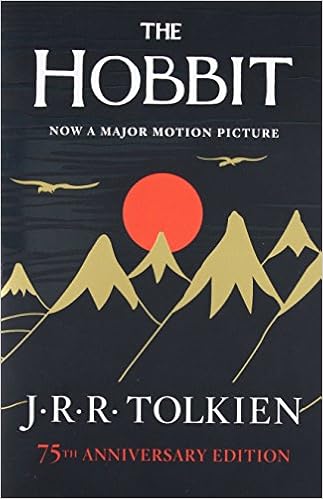
Starting this blog with fantasy only seems right, and what book has influenced the fantasy genre more than The Hobbit? J.R.R. Tolkien's debut novel made fantasy a viable genre for kids and adults alike in a pre-World War II climate. I personally first read this book in middle school and it's no accident that its story and characters have stuck with me ever since. The Hobbit is a classic in its own right and deserving of the praise it gets.
Tolkien was a man of Britain who had served in the First World War some years before the publication of this novel. Tolkien was a linguist and found pleasure in playing with language and making up languages of his own, most featured in his Lord of the Rings trilogy. Tolkien first wrote The Hobbit as a stand-alone novel, starting it from the simple sentence, "In a hole in the ground lived a hobbit." Once he was finished with his novel, Tolkien sent it to many of his peers for critique, including C.S. Lewis. Soon, a publisher read the book and decided to publish it after the publisher's son found it enjoyable. The book was released in September 1937 to critical acclaim.
The version that can be found in your local Barnes & Noble today is at least slightly different from the original publication. Given that Tolkien had no intention of writing any more novels, his original versions of characters, places and events were later revised to accommodate his Lord of the Rings trilogy. For this post, however, I'll be looking at the current version of The Hobbit as it's the one that most are familiar with.
The book opens with Bilbo Baggins, a hobbit who lives in his hobbit hole of Bag End, smoking outside and encountering Gandalf. Gandalf pegs Bilbo as the missing piece of a dwarven expedition to reclaim the Lonely Mountain for Thorin Oakenshield, the leader of the dwarves. Bilbo is initially reluctant but through a series of episodic encounters on their journey to the east, Bilbo grows from a homebody into a brave adventurer. When he returns to Bag End, he is a changed hobbit and is seen as odd by the rest of his race but he has become well-connected and well-respected by many elves and dwarves along the way.
Tolkien structures this novel as a series of episodic events that eventually lead to an end destination. Tolkien was a great lover of classics, even publishing his own translation of "Beowulf", so it stands to reason that Tolkien could have drawn inspiration from the Odyssey, in that both Bilbo and Odysseus go through a series of episodic events that eventually lead them to the Lonely Mountain and Ithaca respectively. Even more telling, both Odysseus and Thorin are traveling through these series of events in order to get home or reclaim their home. The Hobbit reads much like an epic would, where a character goes through numerous trials and tribulations in order for them to grow. Bilbo benefits from these events the most, becoming a more complete person by the end of the novel and carrying off riches both figurative and literal as he makes his way back to the Shire.
Any discussion of The Hobbit is inevitably linked to the trilogy that came after it. The ring of power, or just a ring that made Bilbo invisible in this book, was always in the book but didn't always have any powerful connotation. Tolkien originally intended it to just be a magic ring that helped Bilbo. Tolkien even had Bilbo get the ring by stealing it from Gollum, much different than the accidental pick up that it has been revised to. It's interesting to see the ring in this context as it's almost an afterthought by Bilbo. Bilbo often uses the ring to sneak into places and help the dwarves but nothing particularly bad comes out of it. In fact, the ring is depicted in a positive light most of the time. I wonder if this was a missed opportunity by Tolkien in the revision process.
Another interesting thing to note is how Gandalf disappears to the southern borders of Mirkwood halfway through this book. In the original version, Tolkien had Gandalf go off to finish some business of his own but expanded it in the second version in order to develop the villain Sauron. The movies, directed by Peter Jackson, make this a big point of emphasis as they were more interested in making a prequel to the Lord of the Rings film trilogy. However, it's barely more than a paragraph in the novel. This book doesn't serve as a prequel as it was never made to be so. Therefore, the mention of Gandalf dealing with a dark sorcerer feels almost too neat and serves too much foreshadowing where the book doesn't need it. For a novel that doesn't need to be followed by the trilogy, revisions have made them intrinsically linked to the point that The Hobbit becomes required reading for the Lord of the Rings trilogy. And small additions that Tolkien inserted after the fact make these two novels more connected than perhaps initially intended.
The detail in which J.R.R. Tolkien presents his world of Middle Earth is absolutely mind shattering and deserves a mention all on its own. Tolkien claimed to have drawn inspiration from continental Europe, with the Shire being the English countryside. It's amazing how easily he is able to craft each and every part of this world and give it its own backstory and its own people. The elves of Rivendell and of Mirkwood are given their own chapters, Bilbo travels with a group of dwarves from the mountains, humans populate the town of Dale and the book is framed by the hobbits of the Shire. Each of these races gets their due and give enough that you want to continue reading about these people and the way they interact in this world. Add to the fact that Tolkien made up two elven languages and a dwarven language to coincide with his world, and you have one of the richest fantasy worlds ever created. It's little wonder that the world of Middle Earth has been adapted into video games, board games and the highly successful film adaptations.
The book often reads as an old epic, and its supposed to. Imagine this book is being written by Bilbo himself, reflecting on his past and his adventures. If you do that, you can appreciate just how great the narrative is and how well the narrator is able to engage with a supposed younger audience without patronizing. The narration makes the journey that Bilbo takes all that more interesting to read, especially aloud. Reading through the novel, you get the warm feeling of being read a story by a grandparent. Tolkien has a way of engaging the reader and making them a part of his world better than most of his contemporaries.
Overall, The Hobbit is a classic of fantasy and literature in general. The genius of Tolkien is glimpsed throughout the whole novel, and the world of Middle Earth is given a proper introduction like no other. As soon as a reader begins this novel, they'll want to stay in the company of Bilbo, Thorin, Gandalf and the many faces of Middle Earth for as long as possible. For any who want to delve into a rich and living world, The Hobbit is worth every second that you spend reading it.
The detail in which J.R.R. Tolkien presents his world of Middle Earth is absolutely mind shattering and deserves a mention all on its own. Tolkien claimed to have drawn inspiration from continental Europe, with the Shire being the English countryside. It's amazing how easily he is able to craft each and every part of this world and give it its own backstory and its own people. The elves of Rivendell and of Mirkwood are given their own chapters, Bilbo travels with a group of dwarves from the mountains, humans populate the town of Dale and the book is framed by the hobbits of the Shire. Each of these races gets their due and give enough that you want to continue reading about these people and the way they interact in this world. Add to the fact that Tolkien made up two elven languages and a dwarven language to coincide with his world, and you have one of the richest fantasy worlds ever created. It's little wonder that the world of Middle Earth has been adapted into video games, board games and the highly successful film adaptations.
The book often reads as an old epic, and its supposed to. Imagine this book is being written by Bilbo himself, reflecting on his past and his adventures. If you do that, you can appreciate just how great the narrative is and how well the narrator is able to engage with a supposed younger audience without patronizing. The narration makes the journey that Bilbo takes all that more interesting to read, especially aloud. Reading through the novel, you get the warm feeling of being read a story by a grandparent. Tolkien has a way of engaging the reader and making them a part of his world better than most of his contemporaries.
Overall, The Hobbit is a classic of fantasy and literature in general. The genius of Tolkien is glimpsed throughout the whole novel, and the world of Middle Earth is given a proper introduction like no other. As soon as a reader begins this novel, they'll want to stay in the company of Bilbo, Thorin, Gandalf and the many faces of Middle Earth for as long as possible. For any who want to delve into a rich and living world, The Hobbit is worth every second that you spend reading it.


Comments
Post a Comment